The Chase Sapphire Reserve DoorDash credit used to be one of the easier perks on the card.
If you have the card, you get $25 a month in DoorDash credit. Sounds simple. It isn't. The $25 is split into three separate credits, each with its own rules about where you can spend it. And as of this month, DoorDash just added a $20 minimum order requirement on convenience store pickups, which was the one workaround that let people use the credit without paying anything extra out of pocket.
This is exactly why people are pushing back against the new Chase Sapphire Reserve. The card has some genuinely great features (Chase Points Boost is one of the best things Chase has launched in years), but the way the credits are structured makes the whole card feel like a second job.
The Chase Sapphire Reserve DoorDash Credit, Explained
Before getting into what changed, here's how the credit actually breaks down.
So it isn't one $25 credit. It's three separate credits with three separate rules. If you don't hit all three in a month, the rest expires.
The two $10 credits are the ones most people focus on because they're bigger. They only work on DoorDash's non-restaurant categories, which mainly means DashMart, 7-Eleven, CVS, Safeway, and similar convenience and grocery pickups.
The $5 credit works the opposite way. It only applies to restaurants. So if you want actual food delivery, you're using the smallest of the three.
The Old Way People Maximized the $10 Credit
Before the rule change, there was a clean way to use the $10 non-restaurant credits without paying anything extra. I was doing this every month.
The strategy was simple:
- Go to DoorDash and pick 7-Eleven or DashMart for pickup (not delivery, because delivery adds fees)
- Build an order as close to $10 as possible without going over
- Apply the $10 credit at checkout
- Pay $0 out of pocket and pick up the order yourself
For most people living near a 7-Eleven or a DashMart, this was a covered $10 of household stuff every time a credit reset. Snacks, drinks, basics. Nothing fancy, but the math worked because the order and the credit lined up almost exactly.
What Just Changed: The $20 Minimum for Convenience Pickup
DoorDash just added a $20 minimum order requirement on 7-Eleven and most convenience store pickups.
That single change kills the old strategy. You can no longer build a $10 pickup order and walk out paying nothing. Now you have to spend at least $20, apply the $10 credit, and pay the other $10 out of pocket.
So to use a $10 credit, you now have to spend $10 of your own money. The credit is still worth something, but the value of it has been cut in half for the people who were using it most efficiently.
DoorDash's Reasoning (Straight From Their Own Support)
There's a Reddit thread where users contacted DoorDash support asking why the $20 minimum was added. The response was pretty telling. DoorDash said the minimum was designed to prevent people from maximizing the $10 benefit and to encourage customers to spend more to use the credit.
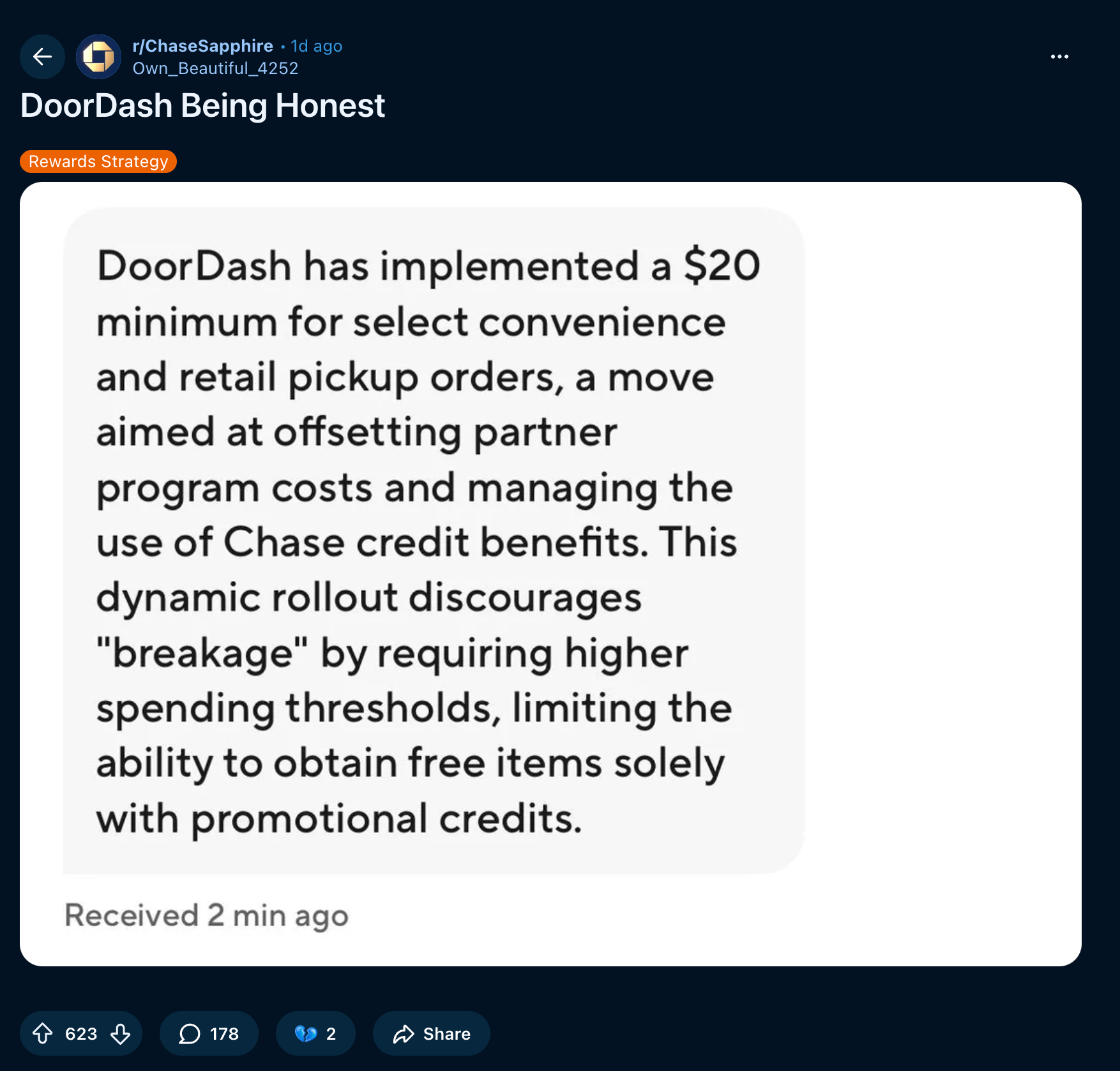
Probably an AI bot response but still it's kind of funny.
To be fair, this isn't entirely on Chase. DoorDash is the one that added the minimum. But Chase picked DoorDash as the partner and structured a credit that only works through DoorDash, so the friction falls on Chase Sapphire Reserve cardholders either way.
This Is Why Amex Is Eating Chase's Lunch
The Amex Platinum has been the gold standard for the coupon book approach to premium credit cards for years. It isn't loved. People complain about the statement credits being annoying and fragmented. But the complaints about Amex are about the concept of the coupon book itself.
The Chase Sapphire Reserve is doing the same thing, except with more layers. The DoorDash credit is a good example of that. Instead of one $25 credit, it's three credits with three different rulesets. And now there's an additional minimum order rule sitting on top of the DoorDash credit specifically.
The Amex Platinum coupon book is frustrating. The Chase Sapphire Reserve coupon book is frustrating and requires more steps to redeem.
When people ask why the Amex Platinum keeps its fans despite the high annual fee, the answer is usually that the benefits are clear and obvious once you learn how to use them. The Chase Sapphire Reserve is now in a place where even the people who know how to use it are finding new hoops to jump through every few months.
My Take
The Chase Sapphire Reserve has real wins. Chase Points Boost is one of the best premium card features in the market right now, and I use it constantly. But the DoorDash credit keeps getting more complicated, and the pattern of the card is pointing in the wrong direction. Every new change seems to add friction instead of removing it. If Chase wants to compete with the Amex Platinum, the benefits have to get simpler, not harder to use.
Bottom Line
The $25 monthly DoorDash credit on the Chase Sapphire Reserve is still worth something. You'd be leaving money on the table if you ignored it. But the math has changed. With the $20 minimum in place, the two $10 non-restaurant credits now require matching your own money to unlock, which puts the card closer to an Amex Platinum style coupon book than it's ever been.
If you hold the card, the play is to set a monthly reminder, use each credit as efficiently as you can, and stop assuming the benefits are going to stay the way they are. The rules keep changing, and they're not changing in your favor.
If you're deciding between the Chase Sapphire Reserve and the Amex Platinum, this is one more factor in favor of Amex right now. Both cards require effort to get full value. The Amex Platinum at least rewards that effort with clearer rules.